Dickon Sowerby
Dickon Sowerby is the moor-born boy whose quiet, animal-charming presence becomes the living bridge between the locked secret garden and the two lonely children who need it most. The twelve-year-old son of Susan Sowerby and brother of Martha, he lives with his large family in a cramped moorland cottage on sixteen shillings a week, yet possesses a wealth of knowledge about the wild that no money could buy. His first appearance in the story—sitting under a tree playing a rough wooden pipe while a brown squirrel clings to the trunk, a cock pheasant peeps from a bush, and two rabbits sit up sniffing with tremulous noses—establishes him at once as a figure who belongs to the natural world as much as to the human one. When he sees Mary Lennox, he holds up his hand and says, "Don't tha' move. It'd flight 'em," speaking in the same low, piping tone he uses with his creatures. From that moment, Dickon functions as the story's most reliable agent of transformation, a boy who "can make a flower grow out of a brick walk" and who understands that "if you're friends with it for sure" anything will respond.
Identity and Background
Dickon Sowerby is the second eldest of twelve children living in a four-room cottage on the edge of the moor. His father earns only sixteen shillings a week, yet the family is described as healthy and good-natured, with the children "tumbling about on th' moor" and growing fat on the grass like wild ponies. Dickon's mother, Susan Sowerby, is a woman of extraordinary practical wisdom whom even Dr. Craven calls "the best sick nurse I know." From her, Dickon has learned not only how to care for living things but how to see the world as a place where "th' Big Good Thing" is always at work. He is twelve years old, with a turned-up nose, round blue eyes "exactly the color of the sky over the moor," a wide curving mouth, and cheeks as red as poppies. His clothes are patched and his speech is broad Yorkshire, but Mary Lennox, who has never liked anyone, declares after meeting him, "I think—I think he's beautiful!" He owns a young moor pony named Jump, which he found as a foal and tamed by feeding it bits of bread and young grass, and he carries a knife for pruning and a pipe for calling his wild companions. His bond with animals is so complete that he says, "Sometimes I think p'raps I'm a bird, or a fox, or a rabbit, or a squirrel, or even a beetle, an' I don't know it."
Role in the Garden's Revival
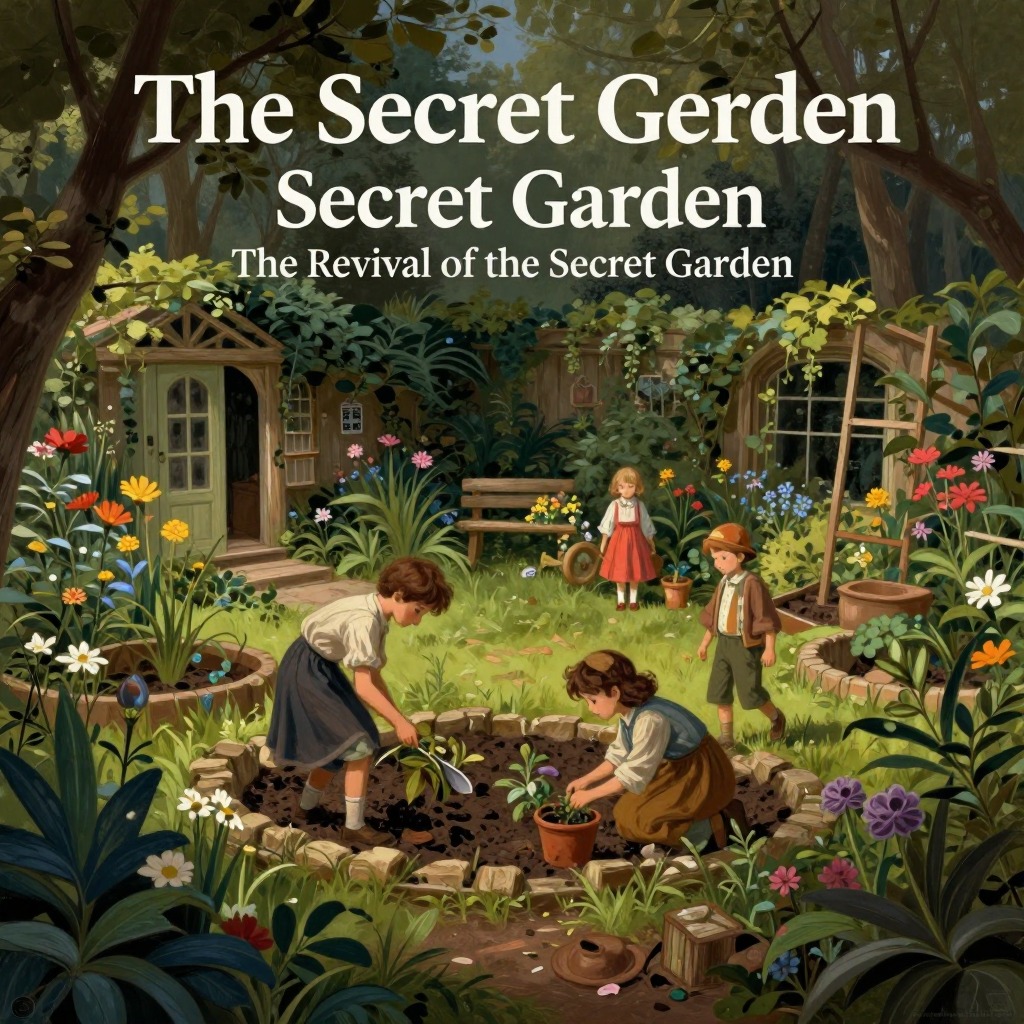
Dickon is the practical and spiritual force behind the secret garden's return to life. When Mary first shows him the locked garden, he walks about softly, taking in the gray tangle of trees and rose-bushes, and immediately sees what is needed. He brings a spade, a rake, a fork, a hoe, and a trowel, along with packets of flower seeds—mignonette, poppies, larkspur, white poppy, blue larkspur—and teaches Mary how to dig, prune, and weed. He shows her how to tell whether a branch is alive by cutting into it: "When it looks a bit greenish an' juicy like that, it's wick." He prunes the dead wood from the old rose-bushes and digs about their roots, predicting that by summer there will be "a fountain o' roses." He also brings his own creatures into the garden—the fox cub Captain, the rook Soot, the squirrels Nut and Shell, and later a newborn lamb—so that the garden becomes a living community. When Colin Craven is introduced to the garden, Dickon pushes his wheelchair through the ivy-covered door and, once inside, helps him stand and walk for the first time. He teaches Colin the muscle exercises he learned from Bob Haworth, the champion wrestler of the moor, and joins in the daily "Magic" ceremonies under the plum-tree canopy, chanting and swaying with the children. His presence reassures even the robin, who recognizes that Dickon "could speak robin" and that his movements are never sudden or threatening.
Relationships and Healing Influence
Dickon's relationships with Mary and Colin are the emotional core of the children's transformation. To Mary, who has never had a friend, Dickon is the fifth person she has ever liked—after his mother, Martha, the robin, and Ben Weatherstaff. She tells him, "You are as nice as Martha said you were," and asks him directly, "Does tha' like me?" He answers heartily, "That I does. I likes thee wonderful, an' so does th' robin, I do believe!" To Colin, who has been isolated and terrified all his life, Dickon represents the possibility of a normal, healthy boyhood. Colin says, "I shouldn't mind Dickon looking at me," and later admits, "I want to see him." When Dickon brings his animals to Colin's room—the lamb on his lap, the fox trotting beside him, the squirrels peeping from his pockets—Colin is overwhelmed with wonder and delight. Dickon never lectures or pities; he simply includes Colin in the work and play of the garden, telling him, "Tha'lt have thee walkin' about here an' diggin' same as other folk afore long." His mother, Susan Sowerby, is the only adult the children fully trust with the secret, and Dickon is the one who brings her into the garden, saying, "I knowed tha' wanted to see her an' I told her where th' door was hid."
Thematic Significance
Dickon embodies the novel's central belief that connection to the natural world is the source of health, joy, and moral growth. He is neither a magical figure nor a sentimental stereotype; his power comes from patient observation, kindness, and a refusal to separate himself from the creatures and plants around him. He lives in poverty but never complains, and his mother's philosophy—that "th' whole orange doesn't belong to nobody"—shapes his generous, unpossessive nature. He is the one who teaches Mary and Colin that "there's naught as nice as th' smell o' good clean earth, except th' smell o' fresh growin' things when th' rain falls on 'em." His Yorkshire dialect, which Mary learns to speak, becomes a language of intimacy and trust. In a story filled with locked doors, buried keys, and hidden grief, Dickon is the figure who simply opens things—the garden, the children's hearts, and the possibility of a life lived in harmony with the turning seasons. He is, as Mary says, "like an angel," but a Yorkshire angel who "understands the green things and knows how to make them grow."